Looking Back and Looking Ahead: One Year of the EXPLORE Act
Last month, Outdoor Alliance’s Vice President for Policy and Government Affairs, Louis Geltman testified in front of Congress about the implementation of the EXPLORE Act, one year after its passage. The EXPLORE Act was the culmination of a decade of work from Outdoor Alliance, our member organizations, and the wider outdoor community to improve and protect outdoor recreation experiences on America’s public lands and waters.
The EXPLORE Act includes a number of bills that Outdoor Alliance and its member organizations helped develop, including the Biking on Long Distance Trails Act (BOLT) to identify and create more long-distance bike trails, the Protecting America's Rock Climbing Act (PARC) to safeguard Wilderness climbing, and the Simplifying Outdoor Access for Recreation Act (SOAR) that will improve recreational permitting for outfitters and guides.
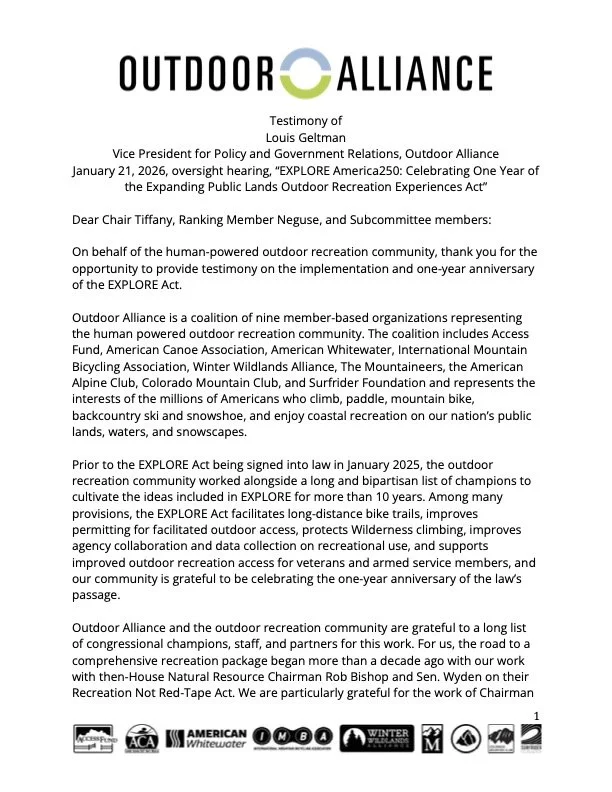
The passage of the EXPLORE Act marked the first comprehensive update to federal recreation policy in decades, but passing the bill was only the first step. Agencies and partners now have to do the hard work of implementing the bill. Last week, Outdoor Alliance’s Vice President for Policy and Government Affairs, Louis Geltman, testified in front of Congress about the implementation of the EXPLORE Act.
In our testimony, we expressed our appreciation that EXPLORE implementation has been a priority for federal land managers. “Our experience with implementation of the EXPLORE Act has been positive, but also mixed. We’re grateful that implementation has been a priority for the administration, but those efforts have been limited by the effects of drastic staff reductions. According to the Office of Personal Management, the Department of the Interior has lost more than 9,000 staff since the beginning of 2025, and the Forest Service has lost more than 8,500 staff over the same period. If the goal of the EXPLORE Act is to improve access to outdoor outdoor recreation, and expand opportunities on public lands and waters, and even if that is fully implemented, we risk those benefits being overwhelmed by the broader negative effects of agency staffing reductions,” said Louis Geltman, Vice President of Policy and Government Relations at Outdoor Alliance.
In June, Secretary of the Interior Doug Burgum signed a secretarial order directing land management agencies to implement the EXPLORE Act, and the U.S. Forest Service has been making encouraging progress towards implementing a number of EXPLORE Act directives that are high priorities for human-powered outdoor recreationists.
At the same time, implementation has been challenged by drastic reductions in agency staffing and efforts to reorganize federal land management agencies. Since the beginning of 2025, agencies like the National Park Service and the U.S. Forest Service have lost around 25% of their staff. These staff reductions have severely affected recreation and recreation-related positions, particularly at the national or regional levels—precisely those most qualified to implement major policy initiatives like the EXPLORE Act.
Outdoor Alliance members including the Access Fund, the International Mountain Biking Association (IMBA), and The Mountaineers have been working in coalition with land managers and other stakeholders to help move the legislation forward.
“Since the BOLT Act passed a year ago as part of the EXPLORE package, we have shifted our focus from the legislative process to partnering directly with the agencies”, said Todd Keller, Director of Government Affairs with the International Mountain Bicycling Association. “Our partners include numerous stakeholders like Bikepacking Roots, People for Bikes, Save the Maah Daah Hey, Oregon Timber Trail, and others have begun to create a database and a report of all of the long- distance trails around the country, and we are excited to share this resource with not only the public but our agency partners as well.”
Erik Murdock, Deputy Director of Access Fund says, “Access Fund is so appreciative of the PARC Act sponsors in both the House and Senate. Congress expressed unanimous support for protecting America’s climbing legacy and ensuring that future generations can access sustainable climbing opportunities on America’s public lands. Since the passage of the PARC Act, climbers and land managers are working toward a unified goal with clear sideboards. We hope the PARC Act will result in a resilient recreation policy supported by land managers, subject matter experts, the climbing community, and all public land visitors.”
From Betsy Robblee, Conservation & Advocacy Director at The Mountaineers, “We're hopeful that once implemented, EXPLORE will lower barriers for people to get outside. Unfortunately, deep staffing cuts at federal land managers have slowed down implementation efforts. We need proper funding and staff to deliver on the promise of the SOAR Act and help more people experience the wonders of the outdoors,” said Betsy Robblee, Conservation & Advocacy Director at The Mountaineers.
From Anneka Williams, Policy Director at Winter Wildlands Alliance, “We were really excited to see the EXPLORE Act pass because it creates a mandate for the USFS and BLM to create and publish motor vehicle use maps in the next five years and over snow vehicle use maps in the next 10 years. This mandate for travel management planning is an important way to balance motorized and non-motorized recreation on public lands. Unfortunately, staffing and funding cuts to federal land management agencies have slowed down implementation efforts. We need sufficient staff and funding, and existing regulatory frameworks that guide travel management, to be in place in order to successfully implement this section of the EXPLORE Act.”
The passage of the EXPLORE Act would not have happened without years of sustained outreach, support, and advocacy from the outdoor recreation community. It also sends a clear message that outdoor recreation and protecting our nation’s public lands are bipartisan priorities. Outdoor Alliance and our member organizations look forward to remaining engaged with both lawmakers and land management agencies so that EXPLORE and each of its provisions are implemented in a way that serves all different recreation types across the country.
To get involved with up to the minute action alerts on the issues you care about, including the EXPLORE Act, sign up below.